
Bubble Trouble
2025 marked both the peak and the decline of the Artificial Intelligence boom. OpenAI, deemed a leading company in AI, closed the year with $8.5 billion in losses, with revenue falling short of investment. In 2026, investors project a $14 billion burn in the company’s revenue. Despite Silicon Valley corporations pouring trillions into models and data centers, weak economics, circular investment, and limited scalability revealed the market’s shortcomings.
In January, Google experienced a surge in interest in Agentic AI, aligning with the hype cycle initiated by OpenAI’s ChatGPT o3-mini Model. Google’s announcement of Gemini 3 framed the end of the chatbot era and the beginning of integrated personal agents with its Pixel 9 phones. From then on, companies rushed to develop machine learning models for contemporary technology. Companies reacted to momentum in the market rather than to long-term user needs.
In spite of efforts from Apple and Microsoft to develop in-house Artificial Intelligence, three companies — Google, Anthropic, and OpenAI — led the Large Language Model race. As competition among search engine companies and emerging California tech giants intensified, manufacturers such as Nvidia, a hardware provider for AI development computing assets, began to benefit. The money concentrated around suppliers instead of the products people actually used.
In May 2025, the company crossed the $4 trillion market-cap milestone, briefly becoming the world’s most valuable company ahead of Apple and Microsoft as technology corporations continue to invest billions in data centers. The AI conversation became a political clash between the United States and China for the AI throne, which the Wall Street Journal dubbed the “new Cold War.” National rivalry amplified both excitement and discouragement with careful economic scrutiny.
By the summer of 2025, OpenAI expanded its data centers to train complex reasoning models, partnering with Oracle and Softbank on Project Stargate, a large-scale data center initiative in the United States. With the support of the Trump administration, OpenAI secured more than $500 billion in development funding over the next five years. This initiative drove an unprecedented demand for GPUs, hardware for model training. Funding expanded faster than measurable returns on these investments.
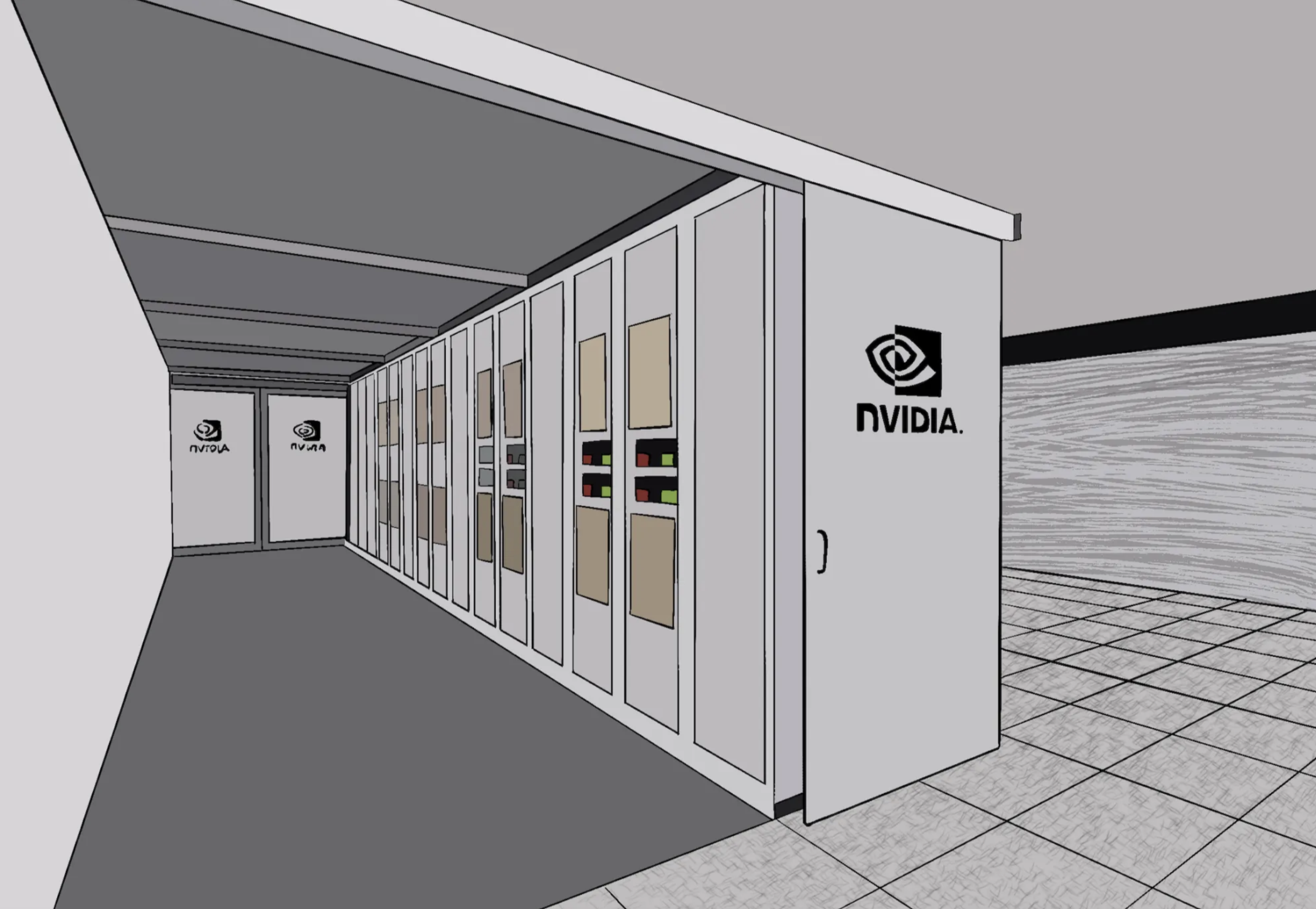
NVIDIA developed an end-to-end accelerated data computing platform. It integrates across hardware and software for enterprises to develop and deploy implementations for AI training
On October 29, 2025, this momentum crystallized. NVIDIA, a Graphics Processing Unit (GPU) manufacturer, became the first company to reach a $5 trillion market capitalization, indicating that the stock market valued the company at $5 trillion. The company’s achievement marked the peak of AI hype. The valuation itself became the story, overshadowing questions about real output.
But since that peak, the story has shifted. Instead of pathbreaking developments, the market experienced a correction. By December, Nvidia’s valuation dipped by roughly 8–10%, eroding nearly $500 billion in market capitalization, equivalent to losing an entire JPMorgan in two months. This shift exposed the crack in the Artificial Intelligence market. The drop forced investors to confront numbers they had previously ignored.
Investors weren’t reacting to a sudden collapse in the technology — they were responding to a market that was funding its demand. Stephanie Aliaga, an investment specialist at J.P. Morgan Asset Management, noted that investors began to scrutinize the circularity of AI markets. Aliaga detailed this troubling loop: chip giants funneled billions into AI startups, which then immediately sent that cash back to those same giants to purchase GPUs. Analysts compared this vendor financing loop to the disastrous telecom bubble of the late 1990s, in which industries sustained artificial growth by funding their own demand.
By November 2025, Wall Street shifted its focus from scaling to solvency and demanded evidence of profit rather than expansion. A MIT study, State of AI in Business 2025, revealed that despite the widespread adoption, 95% of GenAI pilots failed to produce meaningful transformation, ultimately leaving no margin for investors to benefit.
Dr. Gary Marcus, an Emeritus Professor of Psychology and Neural Science at NYU, said, “The technical problems are not new. And a trillion dollars or so of investment hasn’t remedied them.” Dr. Marcus further explained that “If September 2025 was the peak bubble, 2026 will likely be the year in which it all falls apart.”
Echoing such skepticism, the concerns soon reached Silicon Valley itself. In a BBC Interview, Sundar Pichai, the CEO of Google and Alphabet, acknowledged the “irrationality” behind investment in AI industries and said that “no company is going to be immune” in that burst.
While Google maintains a healthy margin through its advertising empire and cloud services, its competitor, OpenAI, lacks a financial safety net. The top AI company now faces a grueling battle to sustain profitability. In December 2025, Sam Altman issued an internal “Code Red” after Google’s Gemini 3 topped industry benchmarks. This emergency directive forced OpenAI’s early release of GPT-5.2 — a move that felt more defensive than a strategic update.

CEOs of Oracle, Softbank, and OpenAI joined President Trump for the Stargate Project. The first Stargate campus is being developed in Abilene, Texas, after the announcement.
This Code Red release exposed OpenAI’s growing fragility. By rushing GPT 5.2 to market less than a month after 5.1, the company prioritized competitive optics. PCMag, an independent technology review magazine, quoted this as “lackluster.” Google currently leads the enterprise field with its integrated infrastructures and services, leaving OpenAI to scramble. Despite OpenAI’s precarious position, the CEO acknowledges the bubbly nature of this market.
AI corporations’ desperation reflects a broader systemic failure that Dr. Aleksandra Przeanlińska, Senior Research Associate at Harvard University, identified as an upcoming 2026 bubble burst. Despite AI investment’s contribution to nearly all of American GDP growth in early 2025, Dr. Przegalińska notes that the technology still fails to deliver on its promise as a productivity tool. She highlights the 95% failure rate for the AI pilot project in the MIT study, suggesting that current Large Language Models often generate “workslops.” This “slop” forces human workers to redo the labor, creating a hidden burden on productivity rather than a benefit.
This failure to deliver high-quality output points to a fundamental flaw in how developers build these systems. Dr. Alfred Spector, a Professor of Practice in the MIT EECS Department and former Vice President of Research and Special Initiatives at Google, argues that technical problems persist because companies often ignore the “context” of data science. In his analysis rubric, Dr. Spector emphasizes that AI applications must account for safety, privacy, and social impact beyond algorithmic accuracy and benchmark performances.
Dr. Spector specifically warns against scrutinizing graphs without context. He demonstrates that altering the chart’s starting point can mislead readers, yielding vastly different insights from the same data. During his tenure at Google, his team developed a metric of gross domestic happiness to illustrate how AI should prioritize “human well-being” and “safety.” His work suggests that the fracture in AI stems in part from a failure to apply data science ethically. To move beyond the bubble, the industry must prioritize human context and objective clarity over raw computational scale.
Artificial Intelligence framed the year 2025. It began with the loud hope of Agentic Tool and ended with a quiet, collective realization of their limits. As the market sheds its valuation untethered from earnings, the era of the AI hype cycle comes to an end, and the AI realism begins.
Originally published in Jets Flyover
